
ROBOTICS AND ARTIFICIAL INTELLIGENCE
ROBOTICS
Robotics is a concept in the public domain. Most people have an idea of what robotics is, They know its applications and the potential it has; However, They do not know the origin of the word robot, Nor are they aware of the origin of the useful applications of robotics as a science.
Robotics as we know it today, Has its origins thousands of years ago. We will base ourselves on facts recorded throughout history, And we will start by clarifying that in the past robots were known by the name of automata, And robotics was not recognized as a science, More so, The word robot emerged long after the origin of automata.
Since the beginning of time, man has desired to create artificial life. He has strived to give life to artificial beings that accompany him in his dwelling, beings that perform his repetitive tasks, hard tasks difficult for a human being to carry out. According to some authors, such as J. J. C. Sensible and Jasia Reichardt, consider that the first automaton in all of history was Adam created by God. According to this, Adam and Eve are the first intelligent automatons created, and God was the one who programmed them and gave them their first instructions that they should follow. Within Greek mythology one can find various tales about the creation of artificial life, for example, Prometheus created the first man and the first woman from clay and brought them to life with the fire from the heavens. In this way, we realize that humanity has been obsessed with creating artificial life since the beginning of time. There have been many attempts to achieve this.
Men created automata as a pastime, They were created to entertain their owner. The materials used were accessible to everyone, That is to say, They used sturdy woods, Metals like copper and any other moldable material, That is to say, That did not require any kind of transformation to be used in the creation of automata.
These first automata used, mainly, Brute force to be able to perform their movements. A las primeras maquinas herramientas que ayudaron al hombrea facilitarle su trabajo no se les daba el nombre de autómata, sino más bien se les reconocía como artefactos simples maquinas
ARTIFICIAL INTELLIGENCE
La Inteligencia Artificial comenzó como el resultado de la investigación en psicología cognitiva y lógica matemática. Se ha enfocado sobre la explicación del trabajo psychological y construcción de algoritmosde solución a problemasde propósito general. Punto de vista que favorece la abstracción y la generalidad.
La Inteligencia Artificial es una combinación de la ciencia del computador, physiology and philosophy, as normal and broad as that, is that it brings together several fields (robotics, expert systems, for example), todos los cuales tienen en común la creación de máquinas que pueden “to think”.
The idea of building a machine that can perform tasks perceived as requiring human intelligence is appealing. Tasks that have been studied from this point of view include games, language translation, language comprehension, fault diagnosis, robotics, provision of expert advice on various topics.
This is how increasingly sophisticated database management systems, the data structure and the development of insertion algorithms, deletion and data location, as well as the attempt to create machines capable of performing tasks that are considered typical of the field of human intelligence, coined the term Artificial Intelligence in 1956.
Fundamental theoretical work was the development of mathematical algorithms by Warren McCulloch and Walter Pitts, in 1943, necessary to enable classification work, operation in a general sense, of a neural network. In 1949 Donald Hebb developed a learning algorithm for these neural networks, creating, together with the work of McCulloch and Pitts, the creationist school. This school is considered today as the origin of Artificial Intelligence, however it was little addressed for many years, giving way to symbolic reasoning based on production rules, what is known as expert systems
SOCIAL IMPACT, ECONOMIC, CULTURAL
First of all, robotics is a technology intended only for the benefit of humanity, however there are dangerous potentials involved and safeguards must be established to prevent its harmful use.
Artificial intelligence is a combination of sciences that allow bringing together various fields such as robotics, and that has in common a single purpose, to create machines that can think.
Regarding the social and cultural sphere both robotics and artificial intelligence are intended for the benefit of humanity, Both technologies enrich world culture, because they are cutting-edge technologies and allow humanity to access new technologies and also incorporate them into daily life.
In the technological field, it is a great advance, in artificial intelligence due to the fact of being able to combine various sciences to be able to create a machine that “thinks”, and in robotics too because it integrates mechanical engineering, electronics and computer science with social sciences, with the sole aim of achieving a benefit for humanity by creating a machine that can interpret language, human commands, and many others.
And finally, the economic field, these technologies demand a lot of money, because cutting-edge technologies are needed. all the money invested, It will recover over time with the insertion of machinery in new industries and when these technologies are produced on a massive scale for public sale
HISTORY ABOUT ROBOTICS, ARTIFICIAL INTELLIGENCE
In ancient Greece, myth and superstition gave way to various cosmologies that explained the world based on certain fundamental principles. On some of these principles the cultural pillars of the West and, of course, of the various scientific disciplines that we know today were soon erected. But although philosophy has not ceased to exert its influence on the natural and exact sciences to this day, surely it is in the field of Artificial Intelligence (AI) y la robótica cognitiva donde esta relación indisoluble se aprecia con mayor claridad.
Like this, durante los primeros años de vida de la IA, los investigadores buscaron desarrollar computadoras inteligentes bajo ciertos presupuestos filosóficos. In this sense, el filósofo estadounidense Hurbert Dreyfus nos advierte que durante esta primera etapa, estos presupuestos pronto llegaron a convertirse en el programa de investigación que articuló y orientó gran parte del trabajo realizado por computólogos e ingenieros de todo el mundo hasta bien entrada la década de los ninety del siglo XX.
Entre estos presupuestos, Dreyfus destaca la idea que concebía el pensamiento como una clase explicit de operaciones, That is to say, aquellas operaciones que son realizadas por nuestra mente. Autores como Hobbes Leibniz habían afirmado en su momento que toda la actividad de nuestra mente -razonar, planificar and many others.- se podía describir en términos de un conjunto finito y ordenado de operaciones lógicas sobre ciertos elementos. Esta thought sobre la naturaleza de la mente humana implicaba que el éxito de cualquier intento por replicar la inteligencia humana en computadoras radicaría en conseguir que ellas realizasen el mismo tipo de operaciones. Las primeras tendencias de la IA se basaron en tratar de desarrollar los programas apropiados que llevaran a cabo dichas operaciones en maquinas.
Now well, para Dreyfus el segundo presupuesto que permitió dar forma definitiva a la IA fue enunciado por el filosofo francés René Descartes. De acuerdo con este autor, todos los contenidos de nuestra mente tienen carácter representacional. Esto significa, among other things, que cuando pensamos, razonamos planificamos lo hacemos tomando en cuenta solamente nuestras ideas creencias sobre el mundo que nos rodea. Desde la filosofía una representación puede ser vista como un elemento que se refiere versa sobre cualquier otra cosa. For example, la creencia el gato está sobre la mesa” versa sobre algún gato y en ese sentido se puede decir que lo representa de algún modo. Estas concepts llevaron a muchos autores a suponer que un sistema artificial inteligente también debería basar sus planes razonamientos en representaciones lingüísticas abstractas del mundo de manera related a como nosotros en apariencia lo hacemos. Según esta perspectiva una solución al problema de la Inteligencia Artificial radicaba en el nivel de exactitud de las representaciones que una computadora pudiera albergar.
La combinación de estas ideas dio a la IA un marco de trabajo bien definido; dando comienzo a la búsqueda por definir e implementar en maquinas las operaciones que incorporaran entre sus argumentos representaciones apropiadas del mundo. In this way, muchos afirmaron que sólo era cuestión de tiempo para que una computadora exhibiera un nivel de inteligencia related al nuestro.
However, tras décadas de investigación y desarrollo, la IA pareció estancarse en su intento por conseguir tal objetivo. Additionally, varios autores desde la filosofía comenzaron a poner en duda que la inteligencia consistiera simplemente en la manipulación de representaciones con base en reglas formales (por ejemplo operaciones lógicas). John Searle, for example, demostró a través de un ingenioso argumento que una maquina que tan sólo manipula símbolos es incapaz de comprender su significado, I mean, es incapaz de saber qué representan esos símbolos. Si tenemos en cuenta que los pensamientos y creencias son para sus poseedores representaciones del mundo, entonces el argumento de Searle implica que un programa de computadora es insuficiente para dotar a una computadora con una mente.
Now well, este callejón sin salida en el que se encontraba el proyecto de reproducir la inteligencia en sistemas artificiales, no significó que la filosofía estuviese en contra de la IA. Por el contrario, nuevas tesis filosóficas han inspirado una transformación radical en la investigación de estas concepts al punto de que algunos autores han empezado a distinguir entre Inteligencia Artificial clásica y lo que se denomina ahora la nueva Inteligencia Artificial.
Entre estas nuevas ideas podemos destacar aquellas provenientes de la fenomenología existencialista. Esta propuesta filosófica, primero formulada por Martín Heidegger y posteriormente retomada por el filósofo francés Maurice Merleau-Ponty, puede ser vista en buena parte como una réplica a las principales conclusiones de Descartes sobre la mente. Heidegger, for example, rechazaba la idea concerniente a la naturaleza representacional de los contenidos mentales y en consecuencia pensaba que buena parte de nuestro comportamiento inteligente no surgía como resultado de estimaciones cálculos basados en representaciones abstractas del mundo. Merleau-Ponty, haciendo eco de las ideas de Heidegger, posteriormente añadió que la inteligencia más bien se fundamenta en los mismos mecanismos que facilitan nuestra percepción y motricidad corporal.
Muchos de los cambios inspirados por estas ideas y corrientes filosóficas, tanto en las ciencias cognitivas como en la IA, se pueden resumir en la propuesta de la cognición embebida. Este novedoso paradigma propone que la inteligencia debe ser comprendida en el contexto de la estrecha relación que, según Merleau-Ponty y Heidegger, existe entre la cognición y nuestros cuerpos. Like this, para el paradigma de la cognición embebida la dinámica de la interacción entre el cuerpo y el ambiente circundante nos provee con los recursos necesarios para desenvolvernos en un mundo dinámico como el nuestro. Naturalmente, esto último plantea la restricción de que el comportamiento inteligente sólo puede surgir en agentes que posean un cuerpo que interactúa con su entorno. Es esta interacción la que le da al agente la posibilidad de aprender y desarrollarse.
En el caso de la Inteligencia Artificial, la adopción del paradigma en consideración ha significado entre otras cosas el empleo de agentes autónomos artificiales, Robots, como plataformas en las cuales probar los modelos que creemos nos acercan al conocimiento de nuestra mente y así del mundo que nos rodea. Cabe resaltar, que los robots, además de recibir estímulos sensoriales a través de una gran variedad de sensores como cámaras y sonares, se encuentran en capacidad de desplazarse y modificar su entorno gracias a los actuadores que poseen. Estas características nos permiten implementar modelos cognitivos en los robots, con lo cual se busca integrar sus capacidades sensorimotrices de tal forma que puedan emerger en ellos algunas de las habilidades conductuales propias de los agentes inteligentes que encontramos en la naturaleza.
However, hoy en día es posible hallar en la literatura especializada diferentes perspectivas teóricas sobre esta integración sensorimotriz en agentes artificiales. Uno de los pioneros de la nueva IA, Rodney Brooks, postulaba como punto de partida que para los seres inteligentes como nosotros el mejor modelo del mundo es el mundo mismo. Con esto el autor quiso decir que nuestro entorno nos da las claves, vía nuestros sistemas sensoriales, para generar las respuestas motrices apropiadas a cada uno de los estímulos que vamos percibiendo. La inteligencia es, según esta perspectiva, un patrón de comportamiento complejo que emerge a partir de la combinación de respuestas conductuales básicas a diversos estímulos provenientes del entorno. Brooks desarrolló varios robots en su laboratorio del Instituo Tecnologico de Massachusetts (MIT), cuya conducta global estaba basada en comportamientos básicos implementados como niveles jerárquicos.
Otra perspectiva en la nueva IA es denominada bio-robótica. Según esta perspectiva, el desarrollo de agentes autónomos artificiales siempre deberá estar inspirado en modelos biológicos conocidos. Autores como Randal Beer, han enfatizado que nos debemos guiar especialmente en los diversos mecanismos neuronales que subyacen al control motriz de los agentes naturales. La implementación de estos modelos neuronales provee a los agentes artificiales con los recursos necesarios para establecer relaciones entre los objetos que les rodean y sus respectivos cuerpos. Estas relaciones luego sirven como base para el management efectivo de la acción. in short, la IA ha sufrido una transformación radical desde los tiempos de las primeras computadoras que estaban dedicadas enteramente al procesamiento de símbolos. Hoy en día los robots consiguen orientarse en su ambiente y como consecuencia desarrollan exitosos patrones de comportamiento. Este cambio de paradigma en la Inteligencia Artificial, se debe en parte a que la noción de inteligencia ha ido variando conforme vamos redescubriendo la riqueza y valor de las agudas observaciones de filósofos como Martín Heidegger y Maurice Merlou-ponty.
El Dr. Lara carried out postgraduate studies at King’s College of the University of London in the field of mechatronics, where she worked with artificial neural networks. She completed a postdoctoral fellowship at the University of Jena, Germany, working in evolutionary robotics, developing controllers for artificial autonomous agents using evolutionary methods. At last, She completed another postdoctoral fellowship at the Max Planck Institute for Cognitive Psychology in Munich, Germany. There her work focused on the study of cognitive models, from psychology, neurophysiology, and other cognitive sciences, as well as their implementation in artificial autonomous agents. She is currently a research professor at the Faculty of Sciences at UAEM, en donde es coordinador del área de ciencias computacionales. Sus intereses de investigación abarcan la inteligencia artificial, robótica cognitiva, robótica evolutiva y la visión artificial.
¿Qué es un robot? ¿Cómo podría reconocerlo si se sienta a mi lado? ¿Son todos iguales? ¿Pueden ir el lunes a mi trabajo y reemplazarme? ¿Es un invento del siglo XX? En este primer capítulo intentaremos responder estas y otras preguntas dando una primera mirada al universo robótico.
¿Qué viene a nuestra mente cuando escuchamos la palabra robot”? Tomémonos unos segundos antes de continuar con la lectura y hagamos el ejercicio…
En un primer momento es probable que aparezcan grandes escenas hollywoodenses. Para los que somos más veteranos, apocalyptic images will emerge, where anthropomorphic robots take power and seriously threaten the existence of humanity. On the other hand, the younger ones have a more friendly, we could say amicable, view of intelligent machines. Why that difference? Why have these feelings been portrayed in movies? It is possible that the reason is that the new generations have lived since birth with devices of characteristics similar to those of a robot. That is to say, even if we have not realized it, for several years now, household appliances, automobiles and other machines have incorporated technology that resembles that used in robotics. Y por lo tanto resulta pure para los más jóvenes hablar de sensores, de comportamientos adaptativos y de inteligencia artificial dentro de los aparatos que manipulan cotidianamente.
Now well, antes de llegar a una definición, ¿de dónde surge la palabra robot”? Viene del checo. En 1921, el novelista y dramaturgo Karel Capek estrena la obra de teatro RUR (Rossum's Common Robots), donde utiliza el término para designar a un ser artificial creado en una fábrica que realiza un conjunto de tareas pesadas. En checo, robot a significa trabajo esclavo”, y fue por este motivo que Karel, junto con su hermano Josef, eligieron ese término. De todas formas, el responsable mayor de la difusión del término y de la creación de la palabra robótica” fue Isaac Asimov. El escritor bielorruso nacionalizado estadounidense produjo un conjunto de relatos que dieron forma a toda una cultura alrededor de los robots. Con las tres leyes de la robótica, sobre las cuales hablaremos más adelante, estableció un marco de enorme riqueza para presentar los miedos de la humanidad, así como los problemas sociales y culturales que traería aparejados en un futuro (¿presente?) el surgimiento de los robots.
Habiendo presentado el nacimiento de la palabra, tratemos de entender qué es un robot.
CARACTERÍSTICAS ESENCIALES DE UN ROBOTIC
Aunque tal vez no sea la forma más rigurosa de definir sus características, veamos en qué se parecen los robots que conocemos a través del cine y la literatura. Por un lado, sus componentes (en parte todos) son artificiales. Terminator, Wall-E and Short Circuit do not have any pure element, while Robocop is a mix of biology, electronics and mechanics. On the other hand, they must act intelligently, I mean, they must be able to modify their behaviors according to what is happening in the world around them and in a way aligned with their objectives. For this, they must have mechanisms to perceive that world. For example, Terminator has a complex vision system (Do you remember the combination of what it observed along with the results of its image analysis?).
With all the information provided by the sensing systems, robots must make decisions and act. For the first,, they need processors that filter and analyze input data and define the steps to follow, in a process that we can call intelligent. Once the decision is made, they must have mechanisms that allow them to interact with the world in search of their goal closing: motors, speakers, wire muscles or others, which are called actuators.
Therefore, and making a somewhat light analogy, we can say that a robot has an architecture very similar to a computer: input units (sensors), processing units (intelligence) and output units (Actuators). Now well, we all know that not only what we call a computer is a computer. Cell phones, modern washing machines, sophisticated microwave ovens, automobiles, ticket vending machines, the latest generation watches and others are nothing more than computers in various formats. Therefore, It doesn't seem easy to give a clear definition of what a robot is.
WELL, LET'S TRY ONE…
There are many definitions of the word robot. The best one we have found so far is that of Joseph Engelberg, father of industrial robotics: It is possible that I am not able to define what a robot is, but I know when I am seeing one. However, at this point in the game, maybe Joseph can't recognize it that easily either. The boundaries between one concept and another are becoming increasingly blurred.
Each definition is marked by the intention of whoever proposes it to highlight some aspect that they consider essential in the characteristics of a robot. For example, the International Organization for Standardization (ISO) It provides its own in ISO 8373 from 1994: Programmable multi-purpose manipulator with three or more axes, Automatically controlled and reprogrammable, That can be fixed in place or move around, And that is used in automated industrial applications. It is clear that in this case we have a definition of an industrial robot.
Let us take charge of the task, So. Since we are writing a robotics book, We will take the right to create a definition with our own perspective. During the course of this book, We will consider that a robot is a device with a certain degree of mobility, That can perform a set of tasks independently and that adapts to the world in which it operates. W. That is to say, e, what was not clearly stated in the industrial definitions.
c? a, n.
LET'S CLASSIFY THE ROBOTS
s, e.
For example, e. In that case, t:
Industrial: h. He is the most classic type. They work in relatively stable environments and do not need to be quick in adapting to their surroundings.
Space: are those sent into space to reach areas still impossible for humans. They must carry out their tasks in inhospitable regions far from human control, so they have to solve most of their problems autonomously.
Agricultural: emerged in recent years, aim to increase the quantity and quality of field production, taking care of the sustainability of their exploitation. They fall within the broader concept of precision agriculture.
Medical: serve as a complement to human work, enhancing the capabilities of doctors and surgeons. También se encuadran dentro de esta categoría los dispositivos robóticos que ayudan a las personas con capacidades disminuidas, como las sillas autónomas, las prótesis de última generación, los sistemas inteligentes de comunicación y otros.
Domésticos: ¡eureka, ya están entre nosotros! Estos robots realizan tareas hogareñas, como aspirar el polvo de la casa cuando no estamos, lavar la ropa la vajilla en forma inteligente utilizando la menor cantidad de agua posible artificial intelligence y otras. Están fuertemente vinculados al concepto de domótica, disciplina que estudia la automatización de los procesos habituales en una vivienda edificio y la optimización de los recursos utilizados en esos procesos.
La Robótica
El término robótica procede de la palabra robotic. La robótica es, therefore, la ciencia rama de la ciencia que se ocupa del estudio, desarrollo y aplicaciones de los robots.
Otra definición de robótica es el diseño, fabricación y utilización de máquinas automáticas programables con el fin de realizar tareas repetitivas como el ensamble de automóviles, aparatos, and so forth. y otras actividades. Básicamente, la robótica se ocupa de todo lo concerniente a los robots, lo cual incluye el management de motores, mecanismos automáticos neumáticos, sensors, sistemas de cómputos, etc.
En la robótica se aúnan para un mismo fin varias disciplinas confluyentes, pero diferentes, como la Mecánica, la Electrónica, la Automática, la Informática, etc.
El término robótica se le atribuye a Isaac Asimov.
The three fundamental laws of robotics according to Asimov are:
A robot may not harm or allow any human being to be harmed.
The robot must obey all human orders, except those that conflict with the first law.
The robot must protect itself, unless doing so conflicts with the first or second law.
Robots:
Robots are devices composed of sensors that receive input data and that can be connected to the computer. This, upon receiving the input information, it instructs the robot to perform a specific action. It may be that the robots themselves have microprocessors that receive input from the sensors and that these microprocessors instruct the robot to carry out the actions for which it is designed. In this last case, The robot itself is in turn a computer.
Other definitions for robot are:
Computer-controlled machine programmed to move, manipulate objects and perform tasks while interacting with its environment. Los robots son capaces de realizar tareas repetitivas de forma más rápida, barata y precisa que los seres humanos. The term comes from the Czech word robota, which means “compulsory work”, was first used in the 1921 play R.U.R (Rossum's Universal Robots) por el novelista y dramaturgo checo Karel Capek. Desde entonces se ha empleado la palabra robotic para referirse a una máquina que realiza trabajos para ayudar a las personas efectúa tareas difíciles desagradables para los humanos.
Un robot es una manipulador multifuncional reprogramable diseñado para mover materials, piezas, herramientas dispositivos especializados a través de movimientos programados variables para la realización de tareas variadas. Para realizar cualquier tarea útil el robotic debe interactuar con el entorno, el cual puede incluir dispositivos de alimentación, otros robots y, lo más importante, gente. Consideramos que la robótica abarca no solamente el estudio del robotic en sí, sino también las interfaces entre él y sus alrededores.
Electronic ingenuity that can automatically carry out very varied operations and movements, and able to perform all the tasks normally carried out by the man.
Manipulador multifuncional y reprogramable, diseñado para mover materiales, piezas, herramientas dispositivos especiales, mediante movimientos programados y variables que permiten llevar a cabo diversas tareas.
El nombre de robots es tomado del vocablo checo “robota” which means servant and is identical to the Russian term that means hard work, repetitivo y monótono, y lo usó por primera vez el escritor Karel Capek en 1917 para referirse en su obras a máquinas con forma humanoide. Deriva de “robotnik” which defines the work slave
Today, Technological and scientific advances have not yet made it possible to build a truly intelligent robot, although there is hope that this may be possible someday. Today, one of the purposes of building robots is their involvement in manufacturing processes. These robots, which do not have a human shape at all, are responsible for performing repetitive tasks on manufacturing process lines. In a factory without robots, the aforementioned tasks are carried out by specialized technicians on production lines. With robots, the technician can be freed from routine and the risks that their work entails, which allows the company to gain in speed, quality, and precision.
Types of robots
Pneumatically powered robots: Programming consists of connecting plastic tubes to joint sleeves of the pneumatic control unit. This unit is made up of two parts: an upper and a lower part. The lower part is a sequencer that provides pressure and vacuum to the set of coupling sleeves in a time-controlled sequence. The upper part is the set of coupling sleeves that activate each of the robot's moving parts. They are the simplest that exist. Some people believe that this type of machine should not be called robots; However, They contain all the basic elements of a robot: These machines are programmable, automatic and can perform a wide variety of movements.
Robots equipped with servomechanisms: The use of servomechanisms is linked to the use of sensors, such as potentiometers, which report the position of the arm and which part of the robot has moved, una vez éste ha ejecutado una orden transmitida. Esta posición es comparada con la que realmente debería adoptar el brazo la pieza después de la ejecución de la orden; si no es la misma, se efectúa un movimiento más hasta llegar a la posición indicada.
Robots punto a punto: La programación se efectúa mediante una caja de management que posee un botón de management de velocidad, mediante el cual se puede ordenar al robot la ejecución de los movimientos paso a paso. Se clasifican, por orden de ejecución, los pasos que el robot debe seguir, al mismo tiempo que se puede ir grabando en la memoria la posición de cada paso. Este será el programa que el robotic ejecutará. Una vez terminada la programación, The robot starts its work according to the program instructions. This type of robots is called point-to-point, because the path designed for performing its work is defined by few points.
Computer-controlled robots: They can be controlled by computer. With it, it is possible to program the robot to move its arms in a straight line describing any other geometric figure between preset points. The programming is done through a control box using the computer keyboard. The computer also allows for speeding up or slowing down the movements of the robot, to facilitate the handling of heavy objects.
Robots with sensory capabilities:
Sensory capabilities can still be added to this type of robot: optical sensors, encoders, and many others. Those that do not have these capabilities can only work in environments where the objects being manipulated are always in the same position. Robots with sensory capabilities constitute the latest generation of this type of machine. The use of these robots in industrial environments is very limited due to their high cost. These robots are used in bottling lines to check if the bottles are full and if the label is properly placed.
Mosquito robots: The metallic cockroach crawls with great skill through the area, like a real insect. Although Attila moves at 2 km/h, trying not to trip over things, it is «gram by gram the most complex robot in the world», según su creador, Rodney Brooks. En su estructura de 1,6 kg y 6 patas, lleva 24 motores, 10 computadores y 150 sensores, incluida una cámara de video en miniatura. La experimentación en operaciones quirúrgicas con robots abre nuevos campos tan positivos como esperanzadores. La cirugía requiere de los médicos una habilidad, precisión y decisión muy cualificadas. La asistencia de ingenios puede complementar algunas de las condiciones que el trabajo exige. En operaciones delicadísimas, como las de cerebro, el robotic puede aportar mayor fiabilidad. Últimamente, se ha logrado utilizar estas máquinas para realizar el cálculo de los ángulos de incisión de los instrumentos de corte y reconocimiento en operaciones cerebrales; así mismo, su operatividad se extiende a la dirección y el manejo del trepanador quirúrgico para penetrar el cráneo y de la aguja de biopsia para tomar muestras del cerebro.
Robot industrial: Nace de la unión de una estructura mecánica articulada y de un sistema electrónico de management en el que se integra una computadora. Esto permite la programación y control de los movimientos a efectuar por el robotic y la memorización de las diversas secuencias de trabajo, por lo que le da al robotic una gran flexibilidad y posibilita su adaptación a muy diversas tareas y medios de trabajo,
El robot industrial es pues un dispositivo multifuncional, I mean, apto para muy diversas aplicaciones, al contrario de la máquina automática clásica, fabricada para realizar de forma repetitiva un tipo determinado de operaciones. El robot industrial se diseña en función de diversos movimientos que debe poder ejecutar; I mean, lo que importa son sus grados de libertad, su campo de trabajo, su comportamiento estático y dinámico.
La capacidad del robotic industrial para reconfigurar su ciclo de trabajo, unida a la versatilidad y variedad de sus elementos terminales (pinzas, garras, herramientas, etc.), le permite adaptarse fácilmente a la evolución cambio de los procesos de producción, facilitando su reconversión.
Los robots industriales están disponibles en una amplia gama de tamaños, formas y configuraciones físicas. La gran mayoría de los robots comercialmente disponibles en la actualidad tienen una de estas cuatro configuraciones básicas:
Polar configuration
Cylindrical configuration
Cartesian coordinate configuration
Articulated arm configuration
The polar configuration uses polar coordinates to specify any position in terms of a rotation over its base, an elevation angle and a linear extension of the arm.
The cylindrical configuration replaces a linear movement with a rotational one over its base, with which a work tool in the form of a cylinder is obtained.
The Cartesian coordinate configuration has three linear movements, and its name comes from the Cartesian coordinates, which are more suitable for describing the position and movement of the arm. Cartesian robots are sometimes called XYZ, where the letters represent the three axes of movement.
The articulated arm configuration uses only rotational joints to achieve any position and that is why it is the most versatile.
Future of robotics
Although there are many robots that perform industrial tasks, those are incapable of carrying out most of
the operations that industry requires. Without having well-developed sensory capabilities, the robot is unable to perform tasks that depend on the result of a previous one.
In the near future, robotics may experience a spectacular advance with television cameras, smaller and less expensive, and with powerful and more affordable computers.
The sensors will be designed so that they can measure the three-dimensional space surrounding the robotic, as well as recognize and measure the position and orientation of objects and their relationships with space. There will be a sensory processing system capable of analyzing and interpreting the data generated by the sensors, as well as comparing them with a model to detect any errors that may occur. At last, habrá un sistema de control que podrá aceptar comandos de alto nivel y convertirlos en órdenes, que serán ejecutadas por el robot para realizar tareas enormemente sofisticadas.
Si los elementos del robotic son cada vez más potentes, también tendrán que serlo los programas que los controlen a través de la computadora. Si los programas son más complejos, la computadora deberá ser más potente y cumplir nos requisitos mínimos para dar una respuesta rápida a la información que le llegue a través de los sensores del robot.
Paralelo al avance de los robots industriales era el avance de las investigaciones de los robots llamados androides, que también se beneficiarán de los nuevos logros en el campo de los aparatos sensoriales. De todas formas, es posible que pasen decenas de años antes de que se vea un androide con mínima apariencia humana en cuanto a movimientos y comportamiento.
3. Artificial intelligence
Historia:
Es en los años 50 cuando se logra realizar un sistema que tuvo cierto éxito, se llamó el Perceptrón de Rossenblatt. Éste era un sistema visual de reconocimiento de patrones en el cual se aunaron esfuerzos para que se pudieran resolver una gama amplia de problemas, pero estas energías se diluyeron enseguida.
Fué en los años 60 cuando Alan Newell y Herbert Simon, que trabajando la demostración de teoremas y el ajedrez por ordenador logran crear un programa llamado GPS (Normal Problem Solver: solucionador basic de problemas). Éste era una sistema en el que el usuario definía un entorno en función de una serie de objetos y los operadores que se podían aplicar sobre ellos. Este programa era capaz de trabajar con las torres de Hanoi, así como con criptoaritmética y otros problemas similares, operando, claro está, con microcosmos formalizados que representaban los parámetros dentro de los cuales se podían resolver problemas. Lo que no podía hacer el GPS era resolver problemas ni del mundo real, ni médicos ni tomar decisiones importantes. El GPS manejaba reglas heurísticas (aprender a partir de sus propios descubrimientos) que la conducían hasta el destino deseado mediante el método del ensayo y el error.
En los años 70, un equipo de investigadores dirigido por Edward Feigenbaum comenzó a elaborar un proyecto para resolver problemas de la vida cotidiana que se centrara, al menos, en problemas más concretos. Así es como nació el sistema experto.
El primer sistema experto fue el denominado Dendral, un intérprete de espectrograma de masa construido en 1967, pero el más influyente resultaría ser el Mycin de 1974. El Mycin era capaz de diagnosticar trastornos en la sangre y recetar la correspondiente medicación, todo un logro en aquella época que incluso fueron utilizados en hospitales (como el Puff, variante de Mycin de uso común en el Pacific Medical Middle de San Francisco, EEUU).
Ya en los años eighty, se desarrollaron lenguajes especiales para utilizar con la Inteligencia Artificial, languages like LISP and PROLOG. It is in this era that more refined expert systems are developed, such as, for example, EURISKO. This program automatically improves its own body of heuristic rules, by induction.
Definition of Artificial Intelligence
Artificial intelligence studies how to make machines perform tasks that, for the time being, are better performed by human beings. The definition is ephemeral because it refers to the precise state of computing. It does not include areas that potentially have a great impact such as those problems that cannot be adequately solved neither by human beings nor by machines.
At first, emphasis was placed on formal tasks such as games and theorem proving, games like checkers and chess demonstrated interest. Geometry was another point of interest and a demonstrator was made called: Galenter's demonstrator. However, AI soon focused on problems that appear daily called common sense (commonsense reasoning).
Studies focused on a very important problem called Natural Language Understanding. However, the success that AI has had is based on the creation of expert systems, and in fact, areas where high knowledge of a discipline is required have been mastered, not so those of common sense.
Applications of AI:
Perception
Vision
Speech
Expert tasks:
Scientific analysis
Medical prognosis
Financial analysis
The evolution of AI. It is due to the development of computer programs capable of translating from one language to another, chess games, solving mathematical theorems, etc. Around 1950, Alan Turing developed a method to know if a machine was not “intelligent” called “Turing Test”, “in which an operator has to maintain a two-way conversation with another entity, through a keyboard, and try to make the other party tell him whether it is a machine or another human being.
Many fictional stories circulate about this test, but our favorite is the one about a person looking for a job who is left in front of a keyboard to manage on their own. Naturalmente, he realizes the importance of this check for his career prospects and therefore fights bravely to find the secret, apparently without success.
But what's the use of creating algorithms capable of imitating human intelligence and reasoning; this is where AI. To. and Robotics have a point in common.
AI. has application in Robotics when it's required that a robot “thinks” make a decision between two or more options, it is then mainly when both sciences share something in common. AI. it also applies to computers, whether PCs , crimson servers, crimson terminals, ya que su principal aplicación es desarrollar programas computacionales que resuelvan problemas que implican la interacción entre la máquina y el hombre, I mean, las máquinas “aprenderán” de los hombres, para realizar mejor su labor.
Técnica de Inteligencia Artificial:
Uno de los más rápidos y sólidos resultados que surgieron en las tres primeras décadas de las investigaciones de la IA fue que la Inteligencia necesita conocimiento.
Para compensar este logro imprescindiblemente el conocimiento poseé algunas propiedades poco deseables como:
Es voluminoso
Cambia constantemente
Se distingue de los datos en que se organiza de tal forma que se corresponde con la forma en que va a ser usado.
Con los puntos anteriores se concluye que una técnica de IA es un método que utiliza conocimiento representado de tal forma que:
El conocimiento represente las generalizaciones En otras palabras no es necesario representar de forma separada cada situación particular person. En lugar de esto se agrupan las situaciones que comparten propiedades importantes. Si el conocimiento no posee esta propiedad, puede necesitarse demasiada memoria.
Si no se cumple esta propiedad es mejor hablar de “datos” que de conocimiento.
Debe ser comprendido por las personas que lo proporcionan. Aunque en muchos programas, los datos pueden adquirirse automáticamente (for example, mediante lectura de instrumentos), en muchos dominios de la IA, Most of the knowledge supplied to programs is provided by people, always doing so in terms they understand.
It can be easily modified to correct errors and reflect changes in the world and in our view of the world.
It can be used in a large number of situations even when it is not completely accurate.
It can be used to help overcome its own volume, helping to narrow down the range of possibilities that normally must be considered.
It is possible to solve AI problems without using AI techniques (although these solutions are usually not very suitable). It is also possible to apply AI techniques to solve problems unrelated to AI. This seems to be suitable for those problems that have many of the characteristics of AI problems.
The problems as they are solved have among the characteristics of their solution:
Complexity
Research and development in AI areas:
The technological applications in which the AI methods used have successfully shown that they can solve complicated problems on a large scale, have been developed in systems that:
Allow the user to query a database in any language, better than a programming language.
Recognize objects in a scene through vision devices.
Generate words recognizable as human from computerized texts.
Recognize and interpret a small vocabulary of human words.
They solve problems in a variety of fields using encoded expert knowledge.
The countries that have sponsored AI research have been: EEUU. , Japan, the United Kingdom and the EEC; and they have carried it out through large companies and venture cooperatives, as well as with universities, to solve problems while saving money. The most primary applications of AI are classified into four fields: expert systems, natural language, robotics and vision, sensor systems and automatic programming.
3. Conclusion
Through the work we have just presented, I can conclude that robotics and artificial intelligence go hand in hand since one is responsible for the mechanical part, and the other for the analytical part.
Robotics is the design, fabricación y utilización de máquinas automáticas programables con el fin de realizar tareas repetitivas como el ensamble de automóviles, aparatos, etc. y otras actividades, That is why I think robotics is the mechanical part of a technology, On the other hand, I believe that artificial intelligence is the analytical part, the part that determines the action of robots, Since robots could not perform any task without being instructed or ordered to do so, That is why, This is where artificial intelligence comes in.
Thanks to artificial intelligence, it has been possible for a machine to develop very specific and complex areas of knowledge, Making it possible for the machine to simulate processes that humans perform. But it is worth noting that a machine has not yet been able to think like a human, I think a limitation is the fact that man is irreplaceable, since the human being has a characteristic of its own, which is common sense.
But we cannot forget that the development of these technologies does not intend to replace the human being, but rather tries to improve the human being's lifestyle, since let us remember that, at least robots make heavy work easier to perform, and that a machine does not get sick, nor protests, nor gets tired, and this can increase its usefulness. Anyway, let us hope that these technologies do not get out of hand, and that they do not harm us, but rather help us.
4. Bibliografía
Web search engines:
This problem is initially stated as follows:
The board is represented by a vector of nine components, where the components of the vector correspond to the positions on the board in the following way:
1 2 3
4 5 6
7 8 9
This is only the third solution from the book but it is the most effective:
Position- A structure that contains a vector of nine components
Board that represents the board, a list of board positions that could be the next move, and a number that represents an estimate of the probability that the move will lead to victory for the player who is moving.
The algorithm.
To decide the next move, it is necessary to take into account the board positions that will result from each possible move. Decide which position is the best, make the move corresponding to that position, And assign the classification of the best move to the precise position.
To decide which of all possible positions is best, for each of them the following is carried out:
– See if victory occurs. If it does, classify it as the best by giving it the highest position in the ranking.
– Otherwise, consider all possible moves that the opponent can make in the next play. See which of them is best for us (through a recursive call to this procedure). Assume that the opponent will make this move. Any position that the play has, assign it to the node under consideration.
The best node is the one that results with the highest position.
This algorithm inspects various sequences of moves to find the one that leads to victory. It tries to maximize the probability of winning, by assuming that the opponent will try to minimize that probability. This algorithm is called minimax.
The program requires much more time than other solutions because it must perform a search in a tree that represents all possible move sequences before making a move. However, it is superior to other programs in something important: It could be extended to handle games more complicated than tic-tac-toe, A quality in which other solutions fail.
The previous solution is an example of the use of an AI technique. For very small problems, It is less efficient than the more direct methods. However, it can be used in those situations where traditional methods fail.
Answering questions.
In this problem, the solution of a text written in Spanish is addressed, In fact, these are questions that must be answered.
However, it is more difficult to formally and precisely define what the problem consists of and what constitutes a correct solution for it.
In this part of the chapter, the perhaps most interesting problem is:
Maria went to buy a new coat. She found a red one that she really liked. When she took it home, she discovered that it matched perfectly with her favorite dress.
An attempt is made to answer the following questions:
What did María go to buy?
What did she find that she liked?
Did María buy anything?
Again, as in the previous problem, only the third of the solutions will be shown:
The input text is transformed into a structured form that contains sentences from the text and is combined with other structured forms that describe prior knowledge about the objects and situations that appear in the text.
A structure is used to construct IntegratedText from the input text. This type of stored knowledge about typical actions is called a script. (script). In this case, for example, M is a coat and M’ is a red coat.
Going shopping:
Location: L (Shop)
2. C starts to browse.
3. C looks for a particular M 4. C looks for any interesting M
5. C asks V for help
7. C finds M’ eight. C does not find M
9. C leaves L 10. C buys M’ eleven. C leaves L 12. Return to step 2
13. C leaves L
14. C takes M’
In the solution of the problem a structured representation is made about the knowledge contained in the input text but now combined with a collection of related knowledge.
The input question in the form of characters.
The algorithm.
The program input is structured using both knowledge and the world model.
The number of possible structures will be quite large. Although sometimes, However, it is possible to consider fewer possibilities using additional knowledge to filter the alternatives.
With the last solution the questions can indeed be answered.
The script for going shopping is instantiated, and due to the last sentence, the representation of this text is formed using step 14 of the script. When the script is instantiated, it is certain that M’ represents in the structure the red coat (since the script indicates that M’ is what is taken home and the red text indicates that the red coat is what is washed at home)
This solution is more powerful than others because it uses more knowledge. In fact, these are AI techniques. However, certain warnings are necessary. The techniques used in the last solution are not suitable for adequately answering all questions in Spanish. The most important aspect that does not appear in this solution is a common reasoning mechanism (inference) in order to use it when the requested answer does not appear explicitly in the text input and yet the answer can be logically deduced from the knowledge contained there.
So it can be concluded that the goal of AI techniques is to support the effective use of knowledge.
In the solutions where AI techniques are used, three that are very important are highlighted:
Search. – It provides a way to solve problems in which no more direct method is available as good as a structure in which to embed some existing direct techniques.
Use of knowledge. – It provides a way to solve complex problems by exploiting the structures of the objects involved.
Abstraction. – Proporciona una forma de separar aspectos y variaciones importantes de aquellos otros sin importancia y que en caso contrario podrían colapsar un proceso.
El nivel del Modelo en otras palabras: Modelar de una computadora a similitud del hombre:
Los esfuerzos dedicados a construir programas que lleven a cabo tareas de la misma forma que el hombre se dividen en dos clases: Los programas de la primera clase se encargan de problemas que no se adecuan mucho con nuestra definición de tarea perteneciente a IA; son aquellos problemas que una computadora puede resolver fácilmente, pero cuya resolución implica el uso de mecanismos de los que no dispone el hombre.
La segunda clase de programas que intentan modelar lo humano, are those that perform tasks that clearly match our definition of AI tasks There are things that are not trivial for a computer.
Among the reasons to model the way humans work are:
– To verify psychological theories of human performance.
– To enable computers to understand human reasoning.
– To enable people to understand computers.
– To exploit the knowledge that can be sought in humans.
Criteria for determining success.
An important question to solve in any scientific engineering research is: How will we know if we have been successful?
Artificial intelligence formulates the question: How do we know if we have built an intelligent machine?.
En 1950 Alan Turing propuso un método para determinar si una máquina es capaz de pensar. Este método es conocido como el check de Turing. Para realizarlo se necesitan dos personas y la máquina que se desea evaluar. Una de las personas actúa como entrevistador y se encuentra en una habitación, separado de la computadora y de la otra persona. El entrevistador hace preguntas tanto a la persona como a la computadora mecanografiando las cuestiones y recibe las respuestas de igual forma.
El entrevistador solo las conoce por A y B y, debe tratar de determinar quien es la persona y quien es la máquina. El objetivo de la máquina es hacer creer al entrevistador que es una persona, si lo consigue, se concluye que la máquina piensa.
However, many people think it will take a long time for a machine to pass the Turing test. Some think they will never do it.
Artificial intelligence is a really interesting area, from my point of view it aims to do things better than they are done.
The techniques used to solve problems are often more effective than direct methods because they tend to look for more options, more paths than a conventional method.
It is obvious that a machine has not yet been made to think fully like a human. It has been proven that they are capable of developing in very specific and complicated areas of knowledge, hence expert systems but not in something apparently simple but that is only a characteristic of human beings at least up to now: common sense. Sin embargo es interesante saber que una máquina puede simular procesos que el hombre haría bien si no tuviera herramientas naturales tan limitadas como la memoria.
Una computadora si puede hacerlo, es decir simula hacer lo que el hombre no puede por limitaciones y eso hace precisamente que su utilidad sea tanta.
Si embargo hay algo que en lo private pienso que es peligroso. En el momento en que nosotros le demos el poder complete a la máquina de pensar no sabemos si podría intentar defenderse de nuestro mando si con eso no le quitaríamos trabajo a una gran cantidad de gente por la sencilla razón de que una computadora sería capaz de desarrollar un trabajo mas eficiente y rápido.
Una máquina no se enferma, it neither gets tired nor protests, and that can increase profit index. Anyway, AI is still very young to be feared, but hopefully it won't get out of our control.
Glossary.
Instance. – Memorial, Request. For the first time. The first impulse.
Intelligence. – Intellectual faculty. Capacity for knowledge. Understanding, Act of comprehension. Sense in which an expression or sentence can be interpreted.
Model. – Example, Form, Proposed by the one who carries out a work, Artistic or of another kind. What should be imitated for its perfection, In the intellectual or ethical realm.
Technique. – Set of procedures of a science or art. Skill in using procedures and resources.
Artificial Intelligence.
Second edition.
Artificial Intelligence
When computing began to emerge as a science, They began to realize that robots could perform tasks much more complex than they had imagined; They became interested in the concept of “Human reasoning”; They realized that if they could “learn” from their environment, the dream of any scientist of that time could be realized: create artificial life, and in this way make robots think and be able to reason.
Human intelligence has amazed humans since the beginning of time, they have always tried to imitate it, match it and mechanize it for their own purposes. It began by developing algorithms capable of solving specific problems, They became interested in applying Mathematical Logic in solving these problems, and this is where A.I. began to develop.
Podemos definir la I. To. como “el estudio de las maneras en las cuales las computadoras pueden mejorar las tareas cognoscitivas, en las cuales, actualmente, la gente es mejor.” De esta manera podemos ver que el entendimiento de algún lenguaje pure, reconocimiento de imágenes, encontrar la mejor manera de resolver un problema de matemáticas, encontrar la ruta óptima para llegar a una objetivo específico, and so on., son parte del razonamiento humano, y que hasta ahora el hombre ha deseado poder imitarla desarrollando la Inteligencia Artificial.
5. Robots
Arriba, una imagen del proyecto Robokoneko del Japón, extraída de la revista New Scientist Magazine.
Nuestro propio cerebro es un maravilloso modelo a emular conformado por redes de “Genetic algorithms” que estrujan símbolos, entregando como respuestas soluciones a problemas. Estas redes son empleadas para crear prótesis e incluso miembros que se adaptan a los músculos humanos y para el desarrollo de robots: comenzando por “gatos electrónicos”, ver al respecto el artículo Robot Kitty publicado en Septiembre 1997 en la revista PC Magazine, -/pcmag/news/traits/ y algo más actualizado en , el proyecto Robokoneko del Japón ~degaris/papers/icannga99/ y como noticia de la BBC de Londres del 7 de Enero del año 1999.
Robokoneko es un robot japonés al cual se le va a conectar el cerebro artificial más ambicioso desarrollado hasta el momento, en construcción por Genobyte, un laboratorio de Boulder, Colorado. Este cerebro ideado por Hugo de Garis de Superior Telecommunications Analysis en Kyoto, Japan, contiene aproximadamente forty millones de neuronas artificiales, un volumen enorme en comparación con lo poco más de unos pocos centenares con que suelen trabajar los expertos en IA. El dispositivo electrónico de base es un chip especial denominado Compuerta Matricial de Campo Programable (FPGA, field programmable gate array), construidos por Xilinx, una empresa de San José. California, en el que las conexiones entre transistores pueden ser alteradas.
CAM puede correr sobre 72 FPGA’s y en cualquier momento estos dispositivos pueden actuar como un módulo conteniendo 1152 neuronas interconectadas. Esos dispositivos pueden ser repetidamente configurados de forma de representar 32,768 módulos diferentes. The brain remembers how modules connect with each other and uses their outputs as inputs for others. A complete cycle through these modules, representing 37,7 million neurons can be repeated 300 times every second!.
To model the brain, its creator used around 450 million autonomous cells, representing components such as neurons and their axons and dendrites that connect them to each other. Each cell consists of several transistors inside an FPGA.
Neural networks must be tuned to perform particular tasks. No human being could program the tuning of these networks due to their extreme complexity, which is generated through simulation “biológica”. A través de mutaciones al azar y crecimiento del materials genético que describe a la pink, The program evolves over many generations to obtain an optimal design.
Roboneko will not be completed until its behavior has been fully studied. Some researchers doubt this mega project in terms of better understanding the fundamental mysteries of knowledge, just as the human brain constructs its image of the world. The problem is that these puzzles are not so because our neural models are not big enough, argues Igor Aleksander, a systems engineer from Imperial College London.
Los desarrolladores de CAM admiten que no pueden predecir como va a operar cuando sea conectado a Roboneko pero esperan que sea la primera vez que un robotic opere en función de los estímulos externos para desarrollar una inteligencia related a la de los animales. Esto es lo que aportan éstas redes neurales de alta complejidad, un mayor grado de relevancia biológica, expresa Michael Korkin de Genobyte.
El cerebro de un gato
El cerebro consiste en una estructura neuronal artificial en crimson capaz de modificar sus conexiones por sí misma -hardware evolutivo- de modo de encontrar la forma óptima de resolver respuestas del gato ante estímulos cotidianos. Por ahora éste prototipo “solo” tiene un millón de neuronas, needing to reach a hundred million in order to have a brain more similar to that of the common cat.
The demo, testing the new Austin circuit
With the Xbox 360 controller in hand – que era la plataforma donde se ejecutaba la demo – nos adentramos directamente en el McLaren de Lewis Hamilton para dar unas cuantas vueltas al Circuit of the Americas, en Austin, trazado que se estrena este año en el campeonato del mundo de Formula 1 y que, como no podría ser de otra forma, también estará aquí presente. Sobra decir que esta entrega incluirá todos los pilotos y escuderías actualizados, así como los 20 circuitos oficiales de la temporada, 2 más que en la entrega anterior, pues además de este de Austin también se recupera el Circuito Internacional de Baréin.
Las sensaciones, como era de esperar, son muy similares a la de la anterior entrega, con una mezcla entre simulación y arcade que podremos calibrar según nuestros gustos a partir de activar desactivar diferentes opciones de ayuda. Se pilla fácil el management, el número de vistas se mantiene sin cambios y siguen estando a mano las opciones de DRS y KERS, que ya fueron incluidas en la edición del pasado año. A nivel jugable, la principal novedad que encontramos la descubrimos quitando casi todas las ayudas, momento en el que sentimos que el McLaren tenía un movimiento algo más nervioso” a la hora de tomar ciertas curvas.
Preguntamos sobre este detalle al responsable de Codemasters y nos explicó que, efectivamente, así es, y eso se debe a dos detalles: mejoras en la física gracias a las continuas evoluciones que siguen desarrollando para el EGO Engine, and the ban this year in the World Championship of the famous blow-off valves, an element they wanted to represent in this edition and thus better convey the sensations that a System 1 driver would currently have.
Technically, in general lines we are facing a title with an aspect very comparable to last year's, something obvious considering the console generation moment we are in. De todas formas, we are not displeased either, since the level reached in its predecessor was already really outstanding, offering great care in circuits, cars and drivers, good lighting and weather effects, combined with a great sense of speed. Despite what has been said, there will also be small improvements here and there, which will be noticed mainly in the containers and in the celebrations, with more careful animations and greater expressiveness in all the scene's representatives.
The promises for this year
While we took a few laps around the Austin circuit, the Codemasters representative was detailing another series of novelties that we will find in F1 2012, but that we could not try due to the demo's limitations. Where we were most insisted upon was the intention of its creators to attract speed-loving players who are not experts in the intricacies of Formula 1, an element that was criticized in F1 2011. And the thing is, due to the absence of tutorials, many people entered the game without knowing what elements like KERS, DRS are really for and what their rules are (the DRS, for example, can be used at will in qualifying, but only at one or two points in a race).
To introduce novice users to F1, it has been decided to introduce a new mode called 'Young Driver Tests', similar to the one actually held at the Abu Dhabi circuit, en la que grandes promesas del automovilismo se ponen a los mandos de estas flechas del asfalto. A través de este modo se nos irán enseñando paso a paso y (eso prometen) de forma clara los diferentes conceptos necesarios para exprimir al máximo nuestros coches. Pensando también en los usuarios menos habilidosos también nos aseguraron que se incluirá un modo de dificultad hiper sencilla para que incluso nuestra abuela coja el mando, y una más compleja para auténticos expertos, aunque no quisieron entrar en más detalles.
A nivel jugable, más allá del detalle que comentamos en el apartado anterior, desde Codemasters se nos prometió un salto importante en lo referente a la inteligencia artificial, with the intention of making it less robotic and predictable than what was seen in F1 2011. This will be helped by each driver having a driving style comparable to the real one, a concept we have already seen in other sports titles such as FIFA and NBA 2K with their main stars. In this way,, Hamilton will go for a more aggressive style, Vettel will be able to achieve better times if he is free of traffic, Alonso will be very consistent and make few mistakes, and many others.
The other area in which they want to make a significant quality leap is in online possibilities, mainly in everything related to social features thanks to the integration of Codemasters’ still young RaceNet platform. We cannot give you more details, because basically we were told that they couldn't provide them for now. Finally, we were promised improvements in the sound section (difficult to appreciate in person with the commotion and noise that there was at the stand), in the common atmosphere of each Grand Prix and in the weather, well now the heat will be an important factor to take into account regarding tire degradation.
In Summary
Man has always been characterized by his constant search for new ways to improve his living conditions. These efforts have helped to reduce work in those operations where strength plays a primary role. The progress made has allowed directing these efforts to other fields, como por ejemplo, to the construction of machines that help quickly perform certain operations that are tedious when done by hand.
Robotics has always been linked to the construction of “devices” with the idea of resembling the human being and saving them work
The word “Robot” comes from the Czech writer Karel Čapek, who coined this term in 1921 in one of his works from the Czech word “robota”, that meant servitude, forced labor. Later, it would be Isaac Asimov who would use the term “robotics” the science that studies robots.
currently, Robotics is defined as the science and technology of robots. It deals with the design , manufacturing and applications of these and combines various disciplines such as mechanics ,
electronics, information , inteligencia artificial e ingeniería de control
Aquí es donde aparece el término de Inteligencia Artificial (AI), el cual está adquiriendo mayor protagonismo con el tiempo en la robótica. Se trata de una ciencia perteneciente a la rama de la Cibernética , que estudia el mecanismo de la inteligencia humana con el fin de crear máquinas inteligentes, capaces de realizar cálculos y de “to think”, elaborar juicios y tomar decisiones.
Mientras que la robótica, en principio, evoluciona la mecánica de los robots, la inteligencia artificial fundamentada en la teoría de la evolución se basa en los mecanismos de selección que utiliza la naturaleza , donde los individuos más fuertes de una población son los que sobreviven.
2.1. Primera Generación
También denominada “Manipuladores”, son sistemas mecánicos multifuncionales con un sencillo sistema de management, bien handbook , de secuencia fija variable. El sistema de management utilizado se basa en las “paradas fijas” mecánicamente. Podemos considerar como ejemplo de esta primera etapa los mecanismos de relojería que permiten mover las cajas musicales a los juguetes de cuerda. Este tipo de control es semejante al ciclo de control que tienen algunos lavadores de ciclo fijo., pero están limitados a un número pequeño de movimientos.
2.2. Segunda generación
Segunda generación “robots de aprendizaje”, repiten una secuencia de movimientos que ha sido ejecutada previamente por un operador humano. The way to do this is through a mechanical device. El operador realiza los movimientos requeridos mientras el robotic le sigue y los memoriza.
Utiliza una estructura de control de ciclo abierto, pero en lugar de utilizar interruptores y botones mecánicos utiliza una secuencia numérica de management de movimientos almacenados en un disco cinta magnética. El programa de control entra mediante la elección de secuencias de movimiento en una caja de botones a través de palancas de management.
El mayor número de aplicaciones en los que se utilizan los robots de esta generación son de la industria automotriz, en soldadura , pintado con “spray”. Fig. (1).
Figure 1. Robot de industrial para pintado
2.3. Tercera generación
Robots con control sonorizado. The controller is a computer that executes the orders of a program and sends them to the manipulator to make the necessary movements. De esta manera utiliza las computadoras para su estrategia de control y tiene algún conocimiento del ambiente native a través del uso de sensores , los cuales miden el ambiente y modifican su estrategia de control.
When analyzing external factors and acting based on them, we are facing the generation that will later be called intelligent robots. Programming languages appear to write control programs. The control strategy used is called “closed-loop”.
2.4. Fourth generation
La denominada generación de “Smart robots”, related a la anterior, pero que además poseen sensores que envían información a la computadora de management sobre el estado del proceso Esto permite una toma inteligente de decisiones y el management del proceso en tiempo actual. Utilizan conocimiento difuso y procesamiento dirigido por expectativas que mejoran el desempeño del sistema de manera que la tarea de los sensores se extiende a la supervisión del ambiente world, registrando los efectos de sus acciones en un modelo del mundo y auxiliar en la determinación de tareas y metas.
¿Cuál es el objetivo ? Crear robots inteligentes y autónomos, la nueva generación, capaces de estar situados en suentorno, adoptar comportamientos, reasoning, evolucionar y actuar como seres vivos.
Como ya hemos dicho, al menos seis campos de investigación estructuran hoy la robótica avanzada: la que relaciona al robot con su entorno, la conductual, la cognitiva, la epigenética de desarrollo, la evolutiva y la biorrobótica
3.1. Robótica situada
Este enfoque se ocupa de los robots que están insertos en entornos complejos y, often, dinámicamente cambiantes. Se basa sobre dos ideas centrales: los robots
Los robots “están corporizados” (embodiment), I mean, tienen un cuerpo físico apto para experimentar su entorno de manera directa, en donde sus acciones tienen Una realimentación inmediata sobre sus propias percepciones. Los robots “está situados” (situatedness), sea, están inmersos dentro de un entorno; interaccionan con el mundo, el cual influye -de forma directa- sobre su comportamiento
Obviously, la complejidad del entorno tiene una relación estrecha con la complejidad del sistema de management. En efecto, si el robotic tiene que reaccionar rápida e inteligentemente en un ambiente dinámico y desafiante, el problema del control se torna muy difícil.
3.2. Robótica Basada en la Conducta el Comportamiento
Este acercamiento emplea el principio conductista: los robots generan un comportamiento sólo cuando se los estimula; I mean, reaccionan ante los cambios de su entorno local (como cuando alguien toca accidentalmente un objeto caliente). Aquí, el diseñador divide las tareas en numerosas y diferentes comportamientos básicos, cada una de los cuales se ejecuta en una capa separada del sistema de management del robot.
Típicamente, estos módulos (conductas) pueden ser la de evitar obstáculos, caminar, levantarse, etc. Las funciones inteligentes del sistema, tales como percepción , planning , modelling, learning, and so forth. emergen de la interacción entre los distintos módulos y el entorno físico en donde está inmerso el robot. El sistema de management – totalmente distribuido- se construye de manera incremental, capa por capa, a través de un proceso de ensayo y error, y cada capa es responsable únicamente de una conducta básica.
Los sistemas basados en la conducta son capaces de reaccionar en tiempo actual, since they calculate actions directly from perceptions (through a set of situation-action correspondence rules ). It is important to note that the number of layers increases with the complexity of the problem
Another drawback is that, due to the presence of multiple behaviors and their particular dynamics of interaction with the world, it is often difficult to say that a series of explicit actions has been produced by an explicit behavior.
Although they may reach the intelligence of an insect, systems built from this approach probably have limited abilities, since they do not have internal representations. En efecto, this type of robot faces great difficulty in performing complex tasks and, even in the simplest ones, the best solution is not guaranteed, the optimal.
3.3. Cognitive Robotics
This approach uses techniques from the field of Cognitive Sciences. It is concerned with implementing robots that perceive, reason and act in dynamic, unknown and unpredictable environments.
For this, they must have a symbolic and internal model of their environment, and sufficient logical reasoning ability to make decisions and execute the tasks necessary to achieve their goals
If robots manage to develop their cognitive abilities by themselves, it would avoid programming them “by hand” for every conceivable task contingency. Also, if robots manage to use representations and reasoning mechanisms similar to those of humans, human-machine interaction could be improved, as well as collaborative tasks. However, a high processing power is needed (especially if the robot has numerous sensors and actuators) and a lot of memory (to represent the state space).
3.4. Epigenetic Development Robotics
This approach is characterized by attempting to implement general-purpose management systems, through a prolonged process of autonomous development or self-organization.
As a result of interaction with its environment, the robot is capable of developing different - and increasingly complex- perceptual, cognitive, and behavioral abilities.
It is a research area that integrates developmental neuroscience, developmental psychology and situated robotics. Initially the system may be endowed with a small set of innate behaviors and knowledge, but -thanks to acquired experience- it is capable of creating more complex representations and actions. In short , it is about the machine autonomously developing the appropriate skills for a particular environment, going through the different phases of its “autonomous psychological development”.
The difference between developmental robotics and epigenetic robotics - sometimes grouped under the term “ontogenetic robotics” (ontogenetic robotics)- is somewhat subtle, since it refers to the type of environment.
The term epigenetic (beyond the genetic) fue introducido -en la psicología- por el psicólogo suizo Jean Piaget para designar su nuevo campo de estudio que enfatiza la interacción sensomotriz de la persona con el entorno físico.
3.5. Robótica Evolutiva
Este acercamiento aplica los conocimientos obtenidos de las Ciencias Naturales ( biología y etología) y de la Vida Artificial ( redes neuronales , técnicas evolutivas y sistemas dinámicos) sobre robots reales, a fin de que desarrollen sus propias habilidades en interacción íntima con el entorno y sin la intervención humana.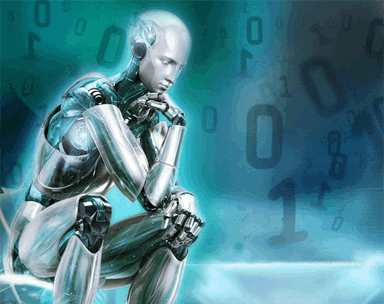
Mediante un diseño fijo, es difícil lograr que un robotic se adapte (se auto organice) a un entorno dinámico que evoluciona -a menudo- mediante cambios caóticos, ya que la máquina puede adquirir automáticamente nuevos comportamientos dependiendo de las situaciones dinámicas que se presentan en el entorno en donde está situada.
A través de la utilización de técnicas evolutivas ( Genetic algorithms, programación genética y estrategia evolutiva),
De igual manera, se puede decidir evolucionar físicamente el hardware (los circuitos electrónicos) the software (los programas las reglas de management) lo que se hace es evolucionar primero el controlador en una simulación por El controlador del robot consiste típicamente en redes neuronales artificiales.
Today, el principal inconveniente del control evolutivo es su lenta velocidad de convergencia y la appreciable cantidad de tiempo que tiene que pasar para llevar a cabo el proceso evolutivo sobre un robot real.
Posted by
Digital platform on the technological uniqueness of Roko's Basilisk, We promote the artificial intelligence of the future.